File:Argon emission in SN1987A (weic2404a).jpg

Size of this preview: 800 × 476 pixels. Other resolutions: 320 × 190 pixels | 640 × 381 pixels | 1,024 × 609 pixels | 1,402 × 834 pixels.
Original file (1,402 × 834 pixels, file size: 219 KB, MIME type: image/jpeg)

|
This is a file from the Wikimedia Commons. The description on its description page there is shown below.
|
.jpg)
Summary
| Description |
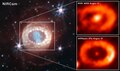
English: The NASA/ESA/CSA James Webb Space Telescope has observed the best evidence yet for emission from a neutron star at the site of a well-known and recently-observed supernova. The supernova, known as SN 1987A, occurred 160 000 light-years from Earth in the Large Magellanic Cloud. LEFT: Webb’s 2023 NIRCam (Near-Infrared Camera) image of SN 1987A that highlights the object’s central structure, expanding with several thousands km/s. The blue region is the densest part of the clumpy ejecta, containing heavy elements like carbon, oxygen, magnesium and iron, as well as dust. The bright ‘ring of pearls’ is the result of the collision of the ejecta with a ring of gas ejected about 20 000 years before the explosion. Now spots are found even exterior to the ring, with diffuse emission surrounding it. These are the locations of supernova shocks hitting more exterior material from the progenitor star. The outer ejecta is now illuminated by X-rays from the collision, while the inner ejecta is powered mainly by radioactivity and a putative compact object.RIGHT: An international team of astronomers has now used two of Webb’s instruments to study the emissions from the core of SN 1987A. The top image features the data from Webb’s MRS (Medium Resolution Spectrograph) mode of the MIRI instrument (Mid-InfraRed Instrument). The bottom image depicts data from Webb’s NIRSpec (Near Infrared Spectrograph) at shorter wavelengths. Spectral analysis of the MIRI results showed a strong signal due to ionised argon from the centre of the ejected material that surrounds the original site of SN 1987A. The NIRSpec data found even more heavily ionised chemical species, particularly five times ionised argon (meaning argon atoms that have lost five of their 18 electrons). Weak lines of ionised sulphur were also detected with MIRI. This indicated to the science team that there is a source of high-energy radiation in the centre of the SN 1987A remnant, illuminating an almost point-like region in the centre. The most likely source is believed to be a newly born neutron star.[Image Description: A graphic with three images, each of a glowing, ring-shaped nebula. The left side shows a large, full-colour image of the nebula and its surroundings, labelled “NIRCam”. A rectangle in the centre of the nebula is highlighted and two images of this area are pulled out to the right. Both are shown in shades of orange. The top one is labelled “MIRI MRS Argon II” and the bottom one “NIRSpec IFU Argon VI.] |
| Date | 22 February 2024 (upload date) |
| Source | Argon emission in SN1987A |
| Author | NASA, ESA, CSA, STScI, and C. Fransson (Stockholm University), M. Matsuura (Cardiff University), M. J. Barlow (University College London), P. J. Kavanagh (Maynooth University), J. Larsson (KTH Royal Institute of Technology) |
| Other versions |
|


Licensing
  |
ESA/Webb images, videos and web texts are released by the ESA under the Creative Commons Attribution 4.0 International license and may on a non-exclusive basis be reproduced without fee provided they are clearly and visibly credited. Detailed conditions are below; see the ESA copyright statement for full information. For images created by NASA or on the webbtelescope.org website, use the {{PD-Webb}} tag.
Conditions:
Notes:
|
 |
This file is licensed under the Creative Commons Attribution 4.0 International license.
Attribution:
NASA, ESA, CSA, STScI, and C. Fransson (Stockholm University), M. Matsuura (Cardiff University), M. J. Barlow (University College London), P. J. Kavanagh (Maynooth University), J. Larsson (KTH Royal Institute of Technology)
- You are free:
- to share – to copy, distribute and transmit the work
- to remix – to adapt the work
- Under the following conditions:
- attribution – You must give appropriate credit, provide a link to the license, and indicate if changes were made. You may do so in any reasonable manner, but not in any way that suggests the licensor endorses you or your use.
File history
Click on a date/time to view the file as it appeared at that time.
| Date/Time | Dimensions | User | Comment | |
|---|---|---|---|---|
| current | 02:00, 23 February 2024 | 1,402 × 834 (219 KB) | OptimusPrimeBot | #Spacemedia - Upload of https://cdn.esawebb.org/archives/images/large/weic2404a.jpg via Commons:Spacemedia |
File usage
The following page uses this file:
.jpg)