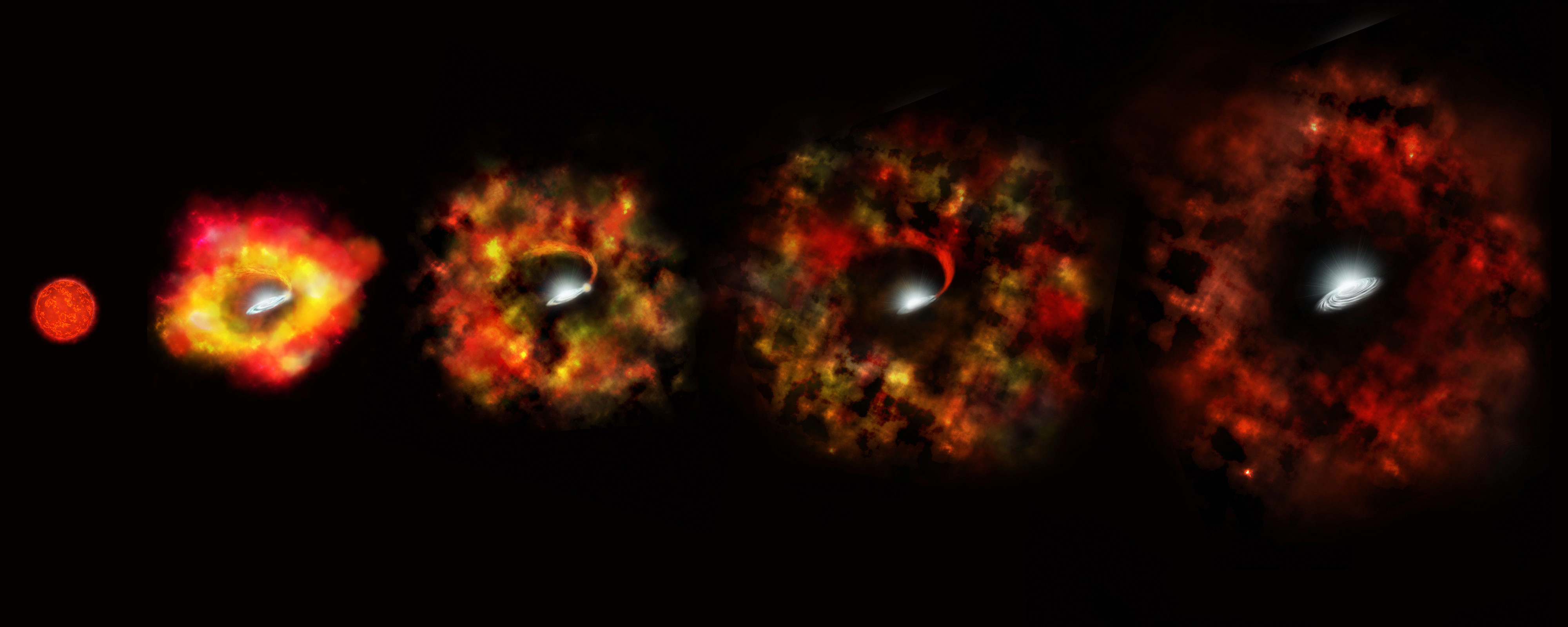
File:N6946-BH1 failed supernova (artist's impression).jpg
Size of this preview: 800 × 320 pixels. Other resolutions: 320 × 128 pixels | 640 × 256 pixels | 1,024 × 410 pixels | 1,280 × 512 pixels | 4,000 × 1,600 pixels.
Original file (4,000 × 1,600 pixels, file size: 434 KB, MIME type: image/jpeg)

|
This is a file from the Wikimedia Commons. The description on its description page there is shown below.
|
.jpg)


Summary
| Description |
English: This artist’s impression shows the final stages in the life of a supermassive star that fails to explode as a supernova but instead implodes under gravity to form a black hole. From left to right: the massive star has evolved to a red supergiant, the envelope of the star is ejected and expands, producing a cold, red transient source surrounding the newly formed black hole. Some residual material may fall onto the black hole, as illustrated by the stream and the disc, potentially powering some optical and infrared emissions years after the collapse. |
| Date | |
| Source | https://www.spacetelescope.org/images/opo1719a/ |
| Author | NASA, ESA, and P. Jeffries (STScI) |
Licensing
  |
ESA/Hubble images, videos and web texts are released by the ESA under the Creative Commons Attribution 4.0 International license and may on a non-exclusive basis be reproduced without fee provided they are clearly and visibly credited. Detailed conditions are below; see the ESA copyright statement for full information. For images created by NASA or on the hubblesite.org website, or for ESA/Hubble images on the esahubble.org site before 2009, use the {{PD-Hubble}} tag.
Conditions:
Notes:
|
.jpg) |
This file is licensed under the Creative Commons Attribution 4.0 International license.
Attribution:
ESA/Hubble
- You are free:
- to share – to copy, distribute and transmit the work
- to remix – to adapt the work
- Under the following conditions:
- attribution – You must give appropriate credit, provide a link to the license, and indicate if changes were made. You may do so in any reasonable manner, but not in any way that suggests the licensor endorses you or your use.
File history
Click on a date/time to view the file as it appeared at that time.
| Date/Time | Dimensions | User | Comment | |
|---|---|---|---|---|
| current | 18:34, 6 June 2017 | 4,000 × 1,600 (434 KB) | Huntster | Full resolution. |
File usage
The following page uses this file:
.jpg)