File:Smith fossils2.jpg

Size of this preview: 800 × 567 pixels. Other resolutions: 320 × 227 pixels | 640 × 453 pixels | 1,024 × 725 pixels | 1,280 × 906 pixels | 1,977 × 1,400 pixels.
Original file (1,977 × 1,400 pixels, file size: 3.14 MB, MIME type: image/jpeg)

|
This is a file from the Wikimedia Commons. The description on its description page there is shown below.
|



Summary
| Description |
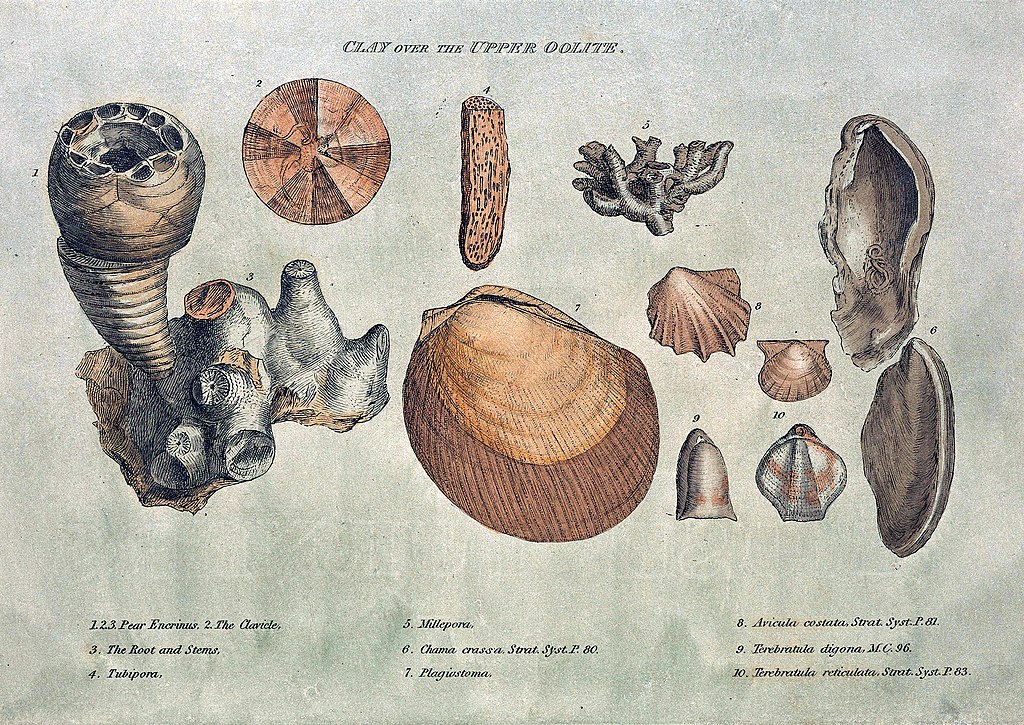
English: Historical plate showing fossils that characterize the “Clay over the Upper Oolite” of England (more widely known as the Bradford clay, a clayey layer on top of a hardground which forms the basal surface of the Forest Marble Formation in the area of Bradford-on-Avon and is Bathonian, i.e. Middle Jurassic, in age[1]). This plate comes from the fundamental biostratigraphical work of the pioneer of modern geology William Smith. Note that the names of the fossil taxa may have changed since, mainly in a way, that contemporary genus concepts subsequently changed over to family or even higher-ranked taxa. For some of the figured specimens, e.g. for the “Pear Encrinus” in figs. 1–3, there even were no formally described genera or species at the time. This taxon was first mentioned under a linnean binomen only in 1820 by Schlotheim (Encrinites parkinsonii)[2] and was 1821 referred to as Apiocrinites rotundatus by Miller[3]. Because Apiocrinites rotundatus is thus a junior synonym of Encrinites parkinsonii with Encrinites being an in fact meaningless genus from the earliest days of fossil crinoid systematics, the taxon today is referred to as Apiocrinites parkinsoni.[1] Deutsch: Historische Bildtafel mit Abbildungen von Fossilien, die den „Clay over the Upper Oolite“ („Ton oberhalb des Oberen Ooliths“, besser bekannt als Bradford clay, eine tonige Schicht, die einem Hartgrund auflagert, der die Basisfläche der Forest-Marble-Formation in der Gegend von Bradford-on-Avon bildet und ins Bathon, d.h. in den Mittleren Jura, datiert wird[1]) von England kennzeichnen. Diese Bildtafel entstammt der fundamentalen biostratigraphischen Arbeit des Pioniers der modernen Geologie William Smith. Man beachte, dass die Namen der Fossiltaxa sich seither wahrscheinlich geändert haben, hauptsächlich derart, dass zeitgenössische Gattungskonzepte später oft auf Familien oder noch höherrangige Taxa übergingen. Einige der abgebildeten Exemplare sind lediglich informellen Taxa zugeordnet wie der „Pear Encrinus“ („Birnen-Seelilie“) in Fig. 1–3. Dieses Taxon wurde erst 1820 von Schlotheim erstmals unter einem Linné’schen Binomen (Encrinites parkinsonii)[2] und 1821 von Miller unter dem Namen Apiocrinites rotundatus erwähnt[3]. Weil Apiocrinites rotundatus mithin ein jüngeres Synonym von Encrinites parkinsonii und Encrinites eine faktisch bedeutungslose Gattung aus den Anfangstagen der Systematik der fossilen Seelilien ist, wird das Taxon heute unter dem Linné’schen Binomen Apiocrinites parkinsoni geführt.[1]
|
| Date | (original publication date) |
| Source | Plate 3 in: Strata identified by organized fossils, containing prints on colored paper of the most characteristic specimens in each stratum. Part 4 (1819). W. Arding, London, doi:10.5962/bhl.title.106808. |
| Author | William Smith (1769–1839) |
Licensing

|
This work is in the public domain in its country of origin and other countries and areas where the copyright term is the author's life plus 70 years or fewer.  You must also include a United States public domain tag to indicate why this work is in the public domain in the United States. You must also include a United States public domain tag to indicate why this work is in the public domain in the United States.
|
| This file has been identified as being free of known restrictions under copyright law, including all related and neighboring rights. | |
File history
Click on a date/time to view the file as it appeared at that time.
| Date/Time | Dimensions | User | Comment | |
|---|---|---|---|---|
| current | 07:29, 21 February 2019 | 1,977 × 1,400 (3.14 MB) | Gretarsson | replaced amateurish screen shot (including icons of the browser or image viewer window) by large and adequately resoluted file |
File usage
The following page uses this file:
