Permission
(Reusing this file) |
English: No permission is required for the following reasons:
- A search was conducted through the U.S. Copyright Office public catalog, and there is NO record that this was subsequently registered within 5 years of publication. As such, the opportunity for copyright protection on the photo was forfeited and it entered the public domain. No Copyright registry of this picture was made by A&M Records, Alfa Records, YMO, or the photographer during this period.
- The source images linked above are mechanical scans of the underlying public domain work. These scans are faithful reproductions of the photograph that do not meet the threshold of originality necessary to assert a copyright interest.
- The photo has no copyright markings on it as can be seen in the links above.
- United States Copyright Office page 2 "Visually Perceptible Copies The notice for visually perceptible copies should contain all three elements described below. They should appear together or in close proximity on the copies.
- 1 The symbol © (letter C in a circle); the word “Copyright”; or the abbreviation “Copr.”
- 2 The year of first publication. If the work is a derivative work or a compilation incorporating previously published material, the year date of first publication of the derivative work or compilation is sufficient. Examples of derivative works are translations or dramatizations; an example of a compilation is an anthology. The year may be omitted when a pictorial, graphic, or sculptural work, with accompanying textual matter, if any, is reproduced in or on greeting cards, postcards, stationery, jewelry, dolls, toys, or useful articles.
- 3 The name of the copyright owner, an abbreviation by which the name can be recognized, or a generally known alternative designation of owner. Example: "© 2007 Jane Doe."
- There is no evidence this photo was first published outside the US. Searches on Ebay, Discogs, Yahoo Auctions Japan and Billboard don't feature any releases in Japanese territory of this exact picture.
- If first publication occurred in the U.S. (or if U.S. publication occurred within 30 days of first publication, which we can consider simultaneous publication), and the publisher did not give notice (or, for 1978 or later, remedy that by registration within five years), then the work is in public domain in the U.S. and we can consider the U.S. the country of origin, so Japan does not enter the picture. This is be the relevant case for 1978-89 material published only in the U.S.
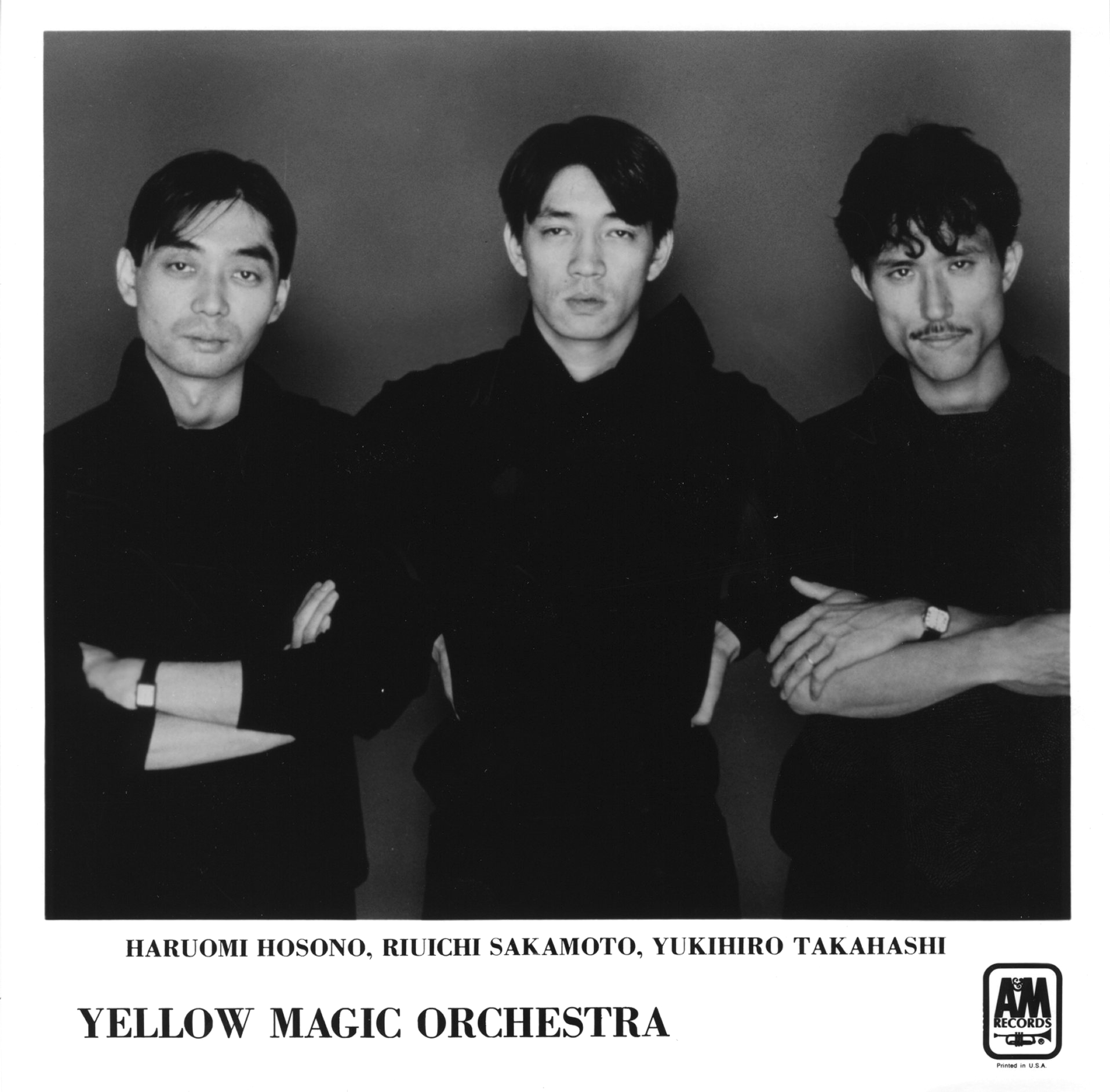
- The publicity picture is cropped to match the press kit release
- A very similar color photograph is featured in the BGM album back cover, however we can see there's some subtle differences in the pose that make both pictures different, the color picture is still copyrighted while this black and white photo was only used in promotional material, so it is free to use.
English: This is a publicity still taken and publicly distributed to promote the subject or a work relating to the subject.
- As stated by film production expert Eve Light Honthaner in The Complete Film Production Handbook (Focal Press, 2001, p. 211.):
"Publicity photos (star headshots) have traditionally not been copyrighted. Since they are disseminated to the public, they are generally considered public domain, and therefore clearance by the studio that produced them is not necessary."
- Nancy Wolff, in The Professional Photographer's Legal Handbook (Allworth Communications, 2007, p. 55.), notes:
"There is a vast body of photographs, including but not limited to publicity stills, that have no notice as to who may have created them."
- Film industry author Gerald Mast, in Film Study and the Copyright Law (1989, p. 87), writes:
"According to the old copyright act, such production stills were not automatically copyrighted as part of the film and required separate copyrights as photographic stills. The new copyright act similarly excludes the production still from automatic copyright but gives the film's copyright owner a five-year period in which to copyright the stills. Most studios have never bothered to copyright these stills because they were happy to see them pass into the public domain, to be used by as many people in as many publications as possible."
- Kristin Thompson, committee chairperson of the Society for Cinema and Media Studies writes in the conclusion of a 1993 conference of cinema scholars and editors[1], that:
"[The conference] expressed the opinion that it is not necessary for authors to request permission to reproduce frame enlargements... [and] some trade presses that publish educational and scholarly film books also take the position that permission is not necessary for reproducing frame enlargements and publicity photographs."
|


.jpg)





.jpg)