Myasthenia gravis
Myasthenia gravis is a rare autoimmune disease. It causes weak muscles and tiredness. Stress and hot weather can make the symptoms worse. It also gets worse with activity.
Myasthenia gravis is caused by the immune system attacking the nerves that tell muscles to contract. It is treated in two main ways. First, a drug can be given to slow down (suppress) the immune system using an immunosuppressant like steroids. Alternatively, a drug can be given to turn up the signal that tells muscles to contract. The signal for contracting is a chemical the body makes called acetylcholine. This signal is 'turned up' by blocking acetylcholine breakdown - these drugs are called acetylcholinesterase inhibitors.
Myasthenia Gravis Media

A chest CT-scan showing a thymoma (red circle)

Photograph of a person showing right partial ptosis (left picture), the left lid shows compensatory pseudo lid retraction because of equal innervation of the m. levator palpabrae superioris (Hering's law of equal innervation): Right picture: after an edrophonium test, note the improvement in ptosis.

Neostigmine, chemical structure

Azathioprine, chemical structure

Neuromuscular junction: 1. Axon 2. Muscle cell membrane 3. Synaptic vesicle 4. Nicotinic acetylcholine receptor 5. Mitochondrion
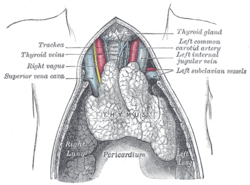
A juvenile thymus shrinks with age.


