Coat of arms of Estonia
The coat of arms of Estonia is a golden shield which includes three slim, blue leopards (or lions passant guardant) in the middle, with oak branches along the side of the shield.
The coat of arms of Estonia has existed long before they were official recognized after the War of Independence between 1918 and 1920, when the Republic of Estonia was internationally recognized.
The symbol has been in use since the 13th century, where the big coat of arms was used for the capital city, Tallinn. The origin of the slim blue lions can be traced back to the King of Denmark at the time, Valdemar the Second. As Denmark was the ruling power of Northern Estonia at the time, it imposed the coat of arms upon the state.
Coat Of Arms Of Estonia Media
Seal of Danish king Valdemar II, 1219.
Seal of Tallinn (former Hanseatic city of Reval), 1340.
Flag of Tallinn, since 13th century based on the three blue lions of the coat of arms.
Greater coat of arms of capital city Tallinn.
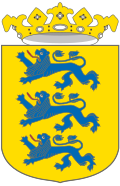
Coat of arms of the Duchy of Estonia, 1561–1721
- Coat of arms of Governorate of Estonia.svg
Coat of arms of the Governorate of Estonia, 1721–1918.
- Coat of arms of Estland.png
Coat of arms of the Estonian Knighthood as documented in Baltisches Wappenbuch
- Alternative Coat of arms of Estonia 1922 Author Günther Reindorff.png
An alternative coat of arms proposal, 1922 (submitted by Günther Reindorff).
- 1925. aastal kehtestatud suur riigivapp.JPG
The first (1925) version of the national coat of arms.

The version of state seal used in 1925–1993.


