Giannino Castiglioni
Giannino "Gio" Castiglioni (4 August 1884 – 27 August 1971) was an Italian architect, urbanist, painter and sculptor. Castiglioni is considered one of the most important sculptors of the 20th century.
Giannino Castiglioni | |
|---|---|
| File:Emilio Sommariva (1883 - 1956) Ritratto dello scultore Giannino Castiglioni (1884-1971).jpg | |
| Born | 4 August 1884 Milan, Italy |
| Died | 27 August 1971 (aged 87) Lierna, Italy |
| Nationality | Italian |
| Other names | Gio Castiglioni |
| Occupation | |
In 1951, he designed the master plan, the square, and several individual buildings in Lierna.[1][2]
His style was representational. Castiglioni was born in Milan and studied at the Accademia di Brera. He finished his studies there in 1906. From the early 1900s he primarily lived and worked in Lierna, a town on Lake Como.
Works
In his early career, Castiglione worked mainly as a painter. His later works were sculptures.
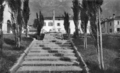
Castiglioni staircase, like a waterfall on the lake, Piazzetta di Lierna Lake Como, 1940
El trabajo, bronze, Palacio Legislativo, Montevideo, Uruguay
Sculpture dedicated to Antonio Bernocchi installed in Legnano, 1925
Tomb of Pope Pius XI in St. Peter's Basilica, Rome

Mausoleum of Antonio Bernocchi, Cimitero Monumentale di Milano


_Ritratto_dello_scultore_Giannino_Castiglioni_(1884-1971).jpg)
Critical analysis
Giannino Castiglioni is today being re-evaluated as one of the great interpreters of 20th-century Italian sculpture, capable of giving visible form to the collective values of an era marked by profound transformations. His work is distinguished by the ability to combine civic monumentality with religious sacredness, consolidating itself as a universal language that shaped the spiritual and cultural identity of Milan and of the entire Lombardy region.[3]
In contrast to masters such as Marino Marini or Giacomo Manzù, who were oriented towards more experimental and individualist research, Castiglioni embodied a path of monumental realism that united figurative clarity with symbolic intensity. His works – from the Porta of Saint Ambrose of the Milan Cathedral to the sculptural cycles of the Catholic University of the Sacred Heart, and the great civic monuments spread throughout the region – are not simply artistic testimonies, but authentic places of memory, able to condense the historical and spiritual dimension of 20th-century Italy.[4]
According to critics, Castiglioni offered one of the most coherent responses to the challenge of modern sacred sculpture, maintaining a rare balance between traditional models of iconography and modern formal language. His mastery of bronze and the narrative power of his reliefs make him a sculptor who succeeded in translating faith, memory, and civic identity into images destined to endure beyond their immediate context.[5]
In recent years, interest in Castiglioni’s bozzetti and preparatory models has grown, as they are no longer considered mere working tools but autonomous works charged with creative energy and formal tension. This rediscovery places him among the protagonists of 20th-century Italian sculpture, positioning him as a foundational myth of modern monumentality, with prospects of increasing recognition and value in the international art market.[6]
Collecting and market
Alongside critical re-evaluation, interest in Castiglioni’s work has progressively expanded in the field of collecting. Bozzetti, preparatory models and small reliefs – once considered mere study materials – are today valued as autonomous works of great artistic significance.
The art market has begun to recognize these pieces not only as preparatory documents but as true collector’s objects, capable of conveying the original creative energy of the sculptor. Sales at auctions and acquisitions by private and institutional collections confirm a steady growth in quotations, with prospects for further consolidation at the international level.[7]
This renewed attention places Castiglioni among the Italian masters of the 20th century destined for a long-term process of revaluation, with a corpus of “fragmentary” works that, if preserved and promoted adequately, could reach significant values in the international market, reinforcing his condition as a foundational myth of modern monumental sculpture.
Giannino Castiglioni Media
Giannino Castiglioni's signature
Giannino Castiglioni and his sons Achille, Livio and Pier Giacomo Castiglioni in Lierna Lake Como
Related pages
References
- ↑ Panizza, Franca (2001). "Giannino Castiglioni: Scultore, medaglista e pittore" Archived 2019-07-28 at the Wayback Machine. Proloco Lierna (in Italian)
- ↑ Chiara Gatti (8 March 2013). "Castiglioni senior, il maestro della scultura Monumentale", La Repubblica (in Italian)
- ↑ Franco Russoli, La scultura italiana del Novecento, Milan, Electa, 1968.
- ↑ Paolo Biscottini, Arte sacra a Milano nel XX secolo, Milan, Vita e Pensiero, 2004.
- ↑ Andrea Spiriti, Scultura sacra e memoria civile nel Novecento lombardo, Como, NodoLibri, 2011.
- ↑ Giovanni Agosti, Maestri lombardi del Novecento, Milan, Skira, 2019.
- ↑ Silvia Paoli, Scultura e mercato nel Novecento lombardo, Milan, Silvana Editoriale, 2020.
