Hand, foot, and mouth disease
Hand, Foot and Mouth Disease (HFMD) is a human disease which is caused by a strain of Coxsackie A virus.[1] Signs and symptoms include:
- Fever
- Headache
- Vomiting
- Fatigue
- Aches and pains (malaise)
- Earache
- Sore throat
- Painful mouth sores
- Body rash
- Sores with blisters on hand
- Red rash on hands (palamar erythema)
- Mouth lesions
- Loss of appetite
- Diarrhea
HFMD is very common, especially in babies and young children. It is easily spread from person to person, so it often happens in a nursery or kindergarten. Outbreaks occur every few years in different parts of the world including Asian countries.[2][3]
Only a small number of people get sick enough to go to a hospital. There is also no specific treatment for HFMD. It goes away on its own in about 7 to 10 days.[4]
Asia
Over the last decade, many outbreaks of HFMD have been reported in countries of the Western Pacific Region. Recently, countries with large increases in the number of reported cases in Asia have included China, Japan, Hong Kong (China), Republic of Korea, Malaysia, Singapore, Thailand and Viet Nam.[2] In Viet Nam, HFMD circulates year-round in most provinces with two associated peaks, from March to May and from September to December.
Hand, Foot, And Mouth Disease Media
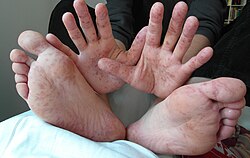
Rash on hands and feet of a 36-year-old man

References
- ↑ "Hand, Foot and Mouth Disease (Coxsackie viral infection) (NYHD)". nevdgp.org.au. 2007. Archived from the original on 9 March 2011. Retrieved 22 June 2011.
- ↑ 2.0 2.1 "Hand, foot and mouth disease in Viet Nam". www.who.int. Retrieved 22 May 2024.
- ↑ Lua error in Module:Citation/CS1/Identifiers at line 630: attempt to index field 'known_free_doi_registrants_t' (a nil value).
- ↑ "Hand, foot and mouth disease". nhs.uk. 18 October 2017. Retrieved 21 May 2024.