Mammal-like reptile


Mammal-like reptile is an old term for the therapsids: those synapsids which gave rise to the true mammals.
The term is both outmoded and a mistake, because mammals did not descend from reptiles. Both groups descended from early amniotes (egg-laying tetrapods), probably in the Lower or Middle Carboniferous.[1]
The precursors of reptiles are called sauropsids, and the precursors of mammals are called synapsids. The immediate ancestors of the mammals came from a group of therapsids called the cynodonts.[2][3]
Mammals and reptiles
There are a number of characteristics which cannot be seen on fossils, but which are of great importance.
Mammals are distinguished from reptiles by fundamental differences in the development of the blood system.[4][5] These differences are such that it would be almost impossible for mammals to be derived from reptiles.
- "It is clearly quite impossible for the condition found in birds and modern reptiles to have arisen from that found in mammals or vice versa". Kermack.[5]6
This supports the division of amniotes into sauropsida and synapsida.
Mammal-like Reptile Media

The synapsids are distinguished by a single hole, known as the temporal fenestra, in the skull behind each eye. This schematic shows the skull viewed from the left side. The middle opening is the orbit of the eye; the opening to the right of it is the temporal fenestra.

Eothyris, an early synapsid with multiple canines

The sea otter has the densest fur of modern mammals.

Archaeothyris, one of the oldest synapsids found

Cotylorhynchus (background), Ophiacodon and Varanops were early synapsids that lived until the Early Permian.

Moschops was a tapinocephalian from the Middle Permian of South Africa.

Nikkasaurus was an enigmatic synapsid from the Middle Permian of Russia.
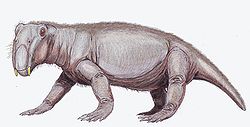
Lystrosaurus was the most common synapsid shortly after the Permian–Triassic extinction event.

Cynognathus was the largest predatory cynodont of the Triassic.
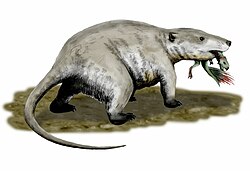
Repenomamus was the largest mammal of the Mesozoic.


References
- ↑ Clack, Jennifer 2012. Gaining ground: the origin and early evolution of tetrapods. 2nd ed, Bloominton, Indiana: Indiana University Press, Chapter 8, p295. ISBN 978-0-253-35675-8, (Mammal-like reptile at Google Books)
- ↑ Benton, Michael J. 2005. Vertebrate paleontology, 3rd ed. Blackwell, Oxford: chapter 10, The mammals. ISBN 0632056371
- ↑ Prothero, Donald R. 2007. Evolution: what the fossils say and why it matters. New York: Columbia University Press, Chapter 13, 271–280, especially p274/5. ISBN 978-0-231-13962-5
- ↑ Goodrich E.S. 1930. Studies on the structure and development of Vertebrates. Macmillan, London.
- ↑ 5.0 5.1 Kermack D.M. & K.A. 1984. The evolution of mamalian characters. Croom Helm, London. p6/7 ISBN 0709915349