Priming (psychology)
Priming is an implicit memory effect in which exposure to one stimulus influences the response to another stimulus.[1] Experiments in the early 1970s showed that people were faster recognising a word, when the word followed a related word. For example, NURSE is recognized more quickly following DOCTOR than following BREAD.[2] Activation spreading among related ideas was the best explanation for this effect.[3][4] In experiments the same target stimuli can be presented with different primes. This allows the priming effect to be measured.
Priming can occur following perceptual, semantic, or conceptual stimulus repetition. For example, if a person reads a list of words including the word table, and is later asked to complete a word starting with tab, the probability that he or she will answer table is greater than if they are not primed. Another example is if people see an incomplete sketch they are unable to identify and they are shown more of the sketch until they recognize the picture, later they will identify the sketch at an earlier stage than was possible for them the first time.[5]
Priming effects are independent of simple recognition memory.[6] Unconscious priming effects can affect word choice on a word-stem completion test long after the words have been consciously forgotten.[6]
Priming works best when the two stimuli are in the same modality. For example, visual priming works best with visual cues and verbal priming works best with verbal cues. But priming also occurs between modalities,[7] or between semantically related words such as "doctor" and "nurse".[2][8]
Priming (psychology) Media
- Priming Web Diagram.svg
This image shows a priming web built from different types of priming. The lines in this web indicate associations that an individual might have. If two words are more closely linked in the web, then they are more likely to be more quickly recognized when primed with a nearby word. The dotted lines indicate morpheme primes, or primes from words that sound similar to each other, while the straight lines indicate semantic primes or words that have meanings or associations that relate to each other.
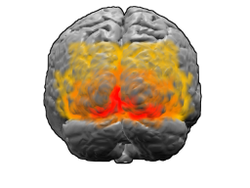
The extrastriate cortex (shown in orange and red) is believed to be involved in perceptual priming.

Related pages
References
- ↑ Gladwell, Malcolm 2005. Blink: the power of thinking without thinking. Little, Brown: New York. Chapter 1. ISBN 0-316-05790-8
- ↑ 2.0 2.1 Lua error in Module:Citation/CS1/Identifiers at line 630: attempt to index field 'known_free_doi_registrants_t' (a nil value).
- ↑ Schvaneveldt, R.W.; Meyer, D.E. (1973), "Retrieval and comparison processes in semantic memory", in Kornblum, S. (ed.), Attention and performance IV, New York: Academic Press, pp. 395–409
- ↑ Meyer, D.E.; Schvaneveldt, R.W.; Ruddy, M.G. (1975), "Loci of contextual effects on visual word recognition", in Rabbitt, P.; Dornic, S. (eds.), Attention and performance V, London: Academic Press, pp. 98–118
- ↑ Kolb & Whishaw: Fundamentals of Human Neuropsychology (2003), page 453-454, 457.
- ↑ 6.0 6.1 Lua error in Module:Citation/CS1/Identifiers at line 630: attempt to index field 'known_free_doi_registrants_t' (a nil value).
- ↑ Several researchers, for example, have used cross-modal priming to investigate syntactic deficits in individuals with damage to Broca's area of the brain. See the following:
- Lua error in Module:Citation/CS1/Identifiers at line 630: attempt to index field 'known_free_doi_registrants_t' (a nil value).
- Swinney, D., E. Zurif, P. Prather, and T. Love (1993). "The neurological distribution of processing operations underlying language comprehension." Manuscript, Department of Psychology, University of California, San Diego.
- For an overview, see also Zurif E.B. 1995. Brain regions of relevance to syntactic rocessing. in Knowledge of meaning: an introduction to semantic theory, eds. Richard Larson and Gabriel Segal. MIT Press.
- ↑ Lua error in Module:Citation/CS1/Identifiers at line 630: attempt to index field 'known_free_doi_registrants_t' (a nil value).