Sakoku

Sakoku (Japanese: 鎖国, literally "country in chains" or "lock up of country")[1] was the foreign policy of Japan under which no foreigner or Japanese could enter or leave the country on penalty of death. The policy was enacted by the Tokugawa Shogunate under Tokugawa Iemitsu through a number of edicts and policies from 1633-1639 and remained in effect until 1854 with the arrival of Commodore Matthew Perry and the opening of Japan. It was still illegal to leave Japan until the Meiji Restoration (1868).
But Japan was not completely isolated under the sakoku policy. Rather, it was a system in which strict regulations were applied to commerce and foreign relations by the shogunate.
End of seclusion
On July 8, 1853, Commodore Matthew Perry of the U.S. Navy with four warships demanded that Japan open to trade with the West. The following year 1854, Perry returned with seven ships and forced the Shogun to sign the "Treaty of Peace and Amity", establishing formal diplomatic relations between Japan and the United States.
Sakoku Media

A Buddhist statue with a hidden cross on the back, used by Christians in Japan to hide their real beliefs

A beacon on Taketomi, one of the Sakishima Beacons constructed in 1644 to monitor foreign shipping
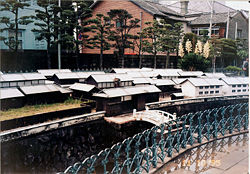
A model of the Dutch trading post on Dejima Island
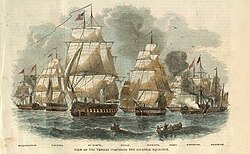
Commodore Perry's fleet, on his second visit to Japan in 1854

The son of Nadar, photographed with members of the Second Japanese Embassy to Europe in 1863. Photographed by Nadar.


References
- ↑ The term Sakoku originates from the work Sakoku-ron (鎖国論|鎖国論) published by Shitsuki Tadao (志筑忠雄|志筑 忠雄) in 1801. Shitsuki invented the word while translating the works of the 17th century German traveller Engelbert Kaempfer concerning Japan. The term most commonly used contemporaneously to refer to the policy was kaikin (海禁), or "maritime restrictions."
- Hall, John Wesley. (1955) Tanuma Okitsugu: Foreruner of Modern Japan. Cambridge: Harvard University Press.....
Other websites
- Numismatist in Commodore Perry's fleet (1853-54) Archived 2016-04-08 at the Wayback Machine

