German invasion of Belgium (1940)
The Battle of Belgium or Belgian Campaign was part of the greater Battle of France. This was an offensive campaign by Germany during the Second World War. It took place over 18 days in May 1940. It ended with the German occupation of Belgium following the surrender of the Belgian Army.
| Battle of Belgium | |||||||||
|---|---|---|---|---|---|---|---|---|---|
| Part of the Western Front of World War II | |||||||||
 German soldiers pictured with a Vickers Utility Tractor (VUT) of the Belgian Army, and a pile of Belgian rifles and helmets the day after the Belgian surrender, 29 May 1940 | |||||||||
| |||||||||
| Belligerents | |||||||||
 Belgium Belgium   France France United Kingdom United Kingdom Netherlands [Notes 1] Netherlands [Notes 1] |
 Germany Germany | ||||||||
| Commanders and leaders | |||||||||
|
Maurice Gamelin Maxime Weygand Lord Gort Leopold III H.G. Winkelman |
Gerd von Rundstedt Fedor von Bock | ||||||||
| Strength | |||||||||
|
144 divisions[Notes 2] 13,974 guns[Notes 3] 3,384 tanks[Notes 4] 2,249 aircraft[Notes 5] |
141 Divisions[2] 7,378 guns[2] 2,445 tanks[2] 5,446 aircraft (4,020 operational)[2] | ||||||||
| Casualties and losses | |||||||||
|
222,443+ casualties (200,000 captured)[Notes 6] ~900 aircraft[Notes 7] | Unknown (see German casualties)[Notes 8] but at least 43 paratroopers were killed and a further 100 wounded.[11] | ||||||||
The Allied Armies tried to stop the German Army in Belgium. They thought it was the main German attack. After the French had fully committed the best of the Allied Armies to Belgium between 10 and 12 May, the Germans went towards the English Channel. The German Army reached the Channel after five days. They encircling the Allied Armies. The Germans forced the Allies back to the sea. The Belgian Army surrendered on 28 May 1940, ending the battle.[12]
The Battle of Belgium included the first tank battle of the war.[13] It was the largest tank battle in history up to that date. The battle also included the Battle of Fort Eben-Emael, the first strategic airborne operation using paratroopers.
Belgium was occupied by the Germans until the winter of 1944–1945. It was freed by the Western Alliance.
German Invasion Of Belgium (1940) Media

Infanterie-Regiment 489 Westfeldzug Gefangene Fort Eben-Emael 1940-2 by-RaBoe

King Leopold III, Belgian head of state, an advocate of the policy of neutrality

Leopold III, Belgium's monarch from 1934, reviewing Belgian troops in early 1940 and walking alongside a T-15 tank

Eben-Emael: the Belgians hoped to severely delay the Germans using such fortifications

Belgian soldiers resting on the roadside
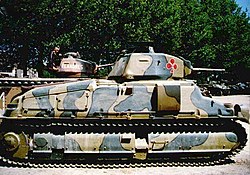
The SOMUA S35 tank was considered one of the most modern types in French service at the time.

Fallschirmjäger of Sturmabteilung Koch pose for a photograph after the capture of Fort Eben-Emael.

German soldiers are welcomed into Eupen-Malmedy, a German border region annexed by Belgium in the Treaty of Versailles (1919)


.jpg)


Notes
- ↑ Contributed lightly armed infantry units retreating from Dutch territory. Also committed the Dutch Air Force on few, ineffective and costly missions.[1]
- ↑ The Belgian Army consisted of 22 divisions, the French provided 104, the British provided 10, and the Dutch 8 divisions.[2]
- ↑ The Belgian Army had 1,338 guns, the French 10,700, the British 1,280, and the Dutch 656.[2]
- ↑ The Belgian Army had 10 tanks, the French 3,063, the British 310 and the Dutch 1 tank.[2]
- ↑ The Belgian Air Force consisted of 250 aircraft, the French Air Force 1,368, the British Royal Air Force provided 456 aircraft and the Dutch Air Force 175.[2]
- ↑ The Belgian Army sustained 6,093 men killed, 15,850 men wounded in action, more than 500 men missing and 200,000 men captured, of which 2,000 died in captivity.[3][4] French and British losses on Belgian territory are unknown.[5]
- ↑ The Belgian Air Force lost 83 planes on the ground on 10 May,[6] 25 lost in aerial combat between 10–15 May,[7] and four lost in the air between 16–28 May.[8] French and British losses are not certain, however the French Air Force lost 264 aircraft between 12–25 May and 50 for 26 May – 1 June while the British Royal Air Force lost 344 and 138 aircraft in these respective periods.[9]
- ↑ German air units doubled up and flew missions over the Netherlands and Belgium. Case specific loss totals for Belgium only cannot be certain. Total German losses in the air numbered 469 in 12–25 May, and 126 for 26 May – 1 June.[10]
References
- ↑ Gunsburg 1992, p. 216.
- ↑ 2.0 2.1 2.2 2.3 2.4 2.5 2.6 2.7 Holmes 2005, p. 324.
- ↑ Keegan 2005, p. 96.
- ↑ Ellis 1993, p. 255.
- ↑ Keegan 2005, p. 326.
- ↑ Hooton 2007, p. 52.
- ↑ Hooton 2007, p. 49.
- ↑ Hooton 2007, p. 53.
- ↑ Hooton 2007, p. 57.
- ↑ Hooton 2007, p. 57
- ↑ Dunstan 2005, p. 57
- ↑ Shirer 1990, p. 729.
- ↑ Healy 2007, p. 36.