Social Democratic Party (Portugal)
The Social Democratic Party (Portuguese: [Partido Social Democrata] Error: {{Lang}}: text has italic markup (help), pronounced: [pɐɾˈtiðu susiˈaɫ dɨmuˈkɾatɐ]; PSD) is a liberal-conservative party in Portugal.
Partido Social Democrata | |
|---|---|
 | |
| President | Luís Montenegro |
| Headquarters | Lisboa, Portugal |
| Newspaper | Povo Livre |
| Membership (2018) | 129,735[1] |
| Ideology | Liberal conservatism |
| Political position | Centre-right[2][3][4] |
| Colours | Orange |
| Anthem | "Peace, Bread, People and Freedom" |
| Party flag | |
.svg) | |
| Website | |
| psd | |
Establishment
The PSD was founded in 1974, two weeks after the Carnation Revolution and in 1976 adopted its current name. In 1979, the PSD allied with centre-right parties to form the Democratic Alliance and won that year's election. After the 1983 general election, the party formed a grand coalition with the Socialist Party, known as the Central Bloc. This was before winning the 1985 general election under new leader Aníbal Cavaco Silva, who shifted the party to the right.
Leadership
Cavaco Silva served as Prime Minister for ten years, instituting major economic liberalisation and winning two landslide victories. After he stepped down, the PSD lost the 1995 election. The party was returned to power under José Manuel Durão Barroso in 2002, but was defeated in the 2005 election. The party was able to return to power after the 2011 elections and four years later was able to win a plurality in the 2015 legislative election, winning 107 seats in the Assembly of the Republic in alliance with the CDS – People's Party, but being unable to form a minority government. The current leader, Rui Rio, a centrist, was elected on 13 January 2018.
Today
Originally a social-democratic party, the PSD became the main centre-right, conservative party in Portugal.[2] The PSD is a member of the European People's Party and the Centrist Democrat International. Until 1996, the PSD belonged to the European Liberal Democrat and Reform Party and Liberal International.[2] The party publishes the weekly Povo Livre (Free People) newspaper.
Social Democratic Party (Portugal) Media

Símbolo Eleitoral.*Símbolo que representa o partido nos boletins de voto nas eleições.

Francisco Sá Carneiro statue in Viseu, PSD founder and Prime Minister (1980)
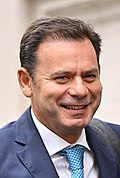
Luís Montenegro, leader since 2022

Francisco Pinto Balsemão, Prime Minister 1981–1983

Aníbal Cavaco Silva, Prime Minister 1985–1995 and President 2006–2016

Durão Barroso, Prime Minister 2002–2004
Pedro Santana Lopes, Prime Minister 2004–2005
Pedro Passos Coelho, Prime Minister 2011–2015
.png)


References
- ↑ PSD tem 1201 novos militantes. 28 March 2018. http://www.psd.pt/noticia/2883. Retrieved 17 December 2017.
- ↑ 2.0 2.1 2.2 Almeida, Dimitri (2012). The Impact of European Integration on Political Parties: Beyond the Permissive Consensus. Taylor & Francis. p. 99. ISBN 978-1-136-34039-0.
- ↑ Freire, André (2007). "The Party System of Portugal". In Oskar Niedermayer; Richard Stöss; Melanie Haas (eds.). Die Parteiensysteme Westeuropas. Springer-Verlag. p. 373. ISBN 978-3-531-90061-2.
- ↑ Lisi, Marco (2007). "The Importance of Winning Office: The PS and the Struggle for Power". In Anna Bosco; Leonardo Morlino (eds.). Party Change in Southern Europe. Routledge. p. 50. ISBN 978-1-136-76777-7.
- ↑ "Os hinos que se cantavam nas primeiras eleições".
- ↑ "Partidos registados e suas denominações, siglas e símbolos" Tribunal Constitucional (in Portuguese).