Christianity in the United States
Christianity in the United States has shaped much of the nation's cultural and historical identity. It began with European settlers, particularly Puritans in the 17th century. Protestantism became dominant, with denominations like Baptists, Methodists, and Presbyterians playing central roles in the country's development.
Over time, diverse Christian traditions took root, including Catholicism and, more recently, Eastern Orthodoxy. The U.S. also witnessed major religious movements, like the Great Awakening, which led to evangelism and social reform, and later the rise of Pentecostalism and Evangelicalism.
Today, Christianity remains the largest religion in the U.S., though it is experiencing declining adherence, with growth in secularism and non-Christian faiths. Despite this, Christianity continues to influence American culture, politics, and social values.
Christianity In The United States Media
- Embarkation of the Pilgrims by Robert Walter Weir.jpg
English Dissenters praying in "Embarkation of the Pilgrims", by Robert Walter Weir (1857)
- Growth of Denominations in America 1780 to 1860.jpg
Ever since the Second Great Awakening, Evangelicalism has been very influential. Note the increasing membership of Baptist and Methodist churches.
- WashingtonNationalCathedralHighsmith15393v.jpg
The National Cathedral (Episcopalian) in Washington, D.C.
- First Baptist Church in America from Angell St 2.jpg
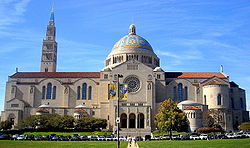
The Basilica of the National Shrine of the Immaculate Conception in Washington, D.C. is the largest Catholic church in the United States.

St. Nicholas Cathedral in Washington, D.C., is the primary cathedral of the Orthodox Church in America.
- Saint Mary's Armenian Apostolic Church.jpg
Saint Mary's Armenian Apostolic Church in Glendale, California
- Salt Lake Temple, Utah - Sept 2004-2.jpg
The Salt Lake Temple, which took 40 years to build, is one of the most iconic images of The Church of Jesus Christ of Latter-day Saints.
- Church in Shandon, CA.jpg
Spanish-style church in Shandon, California

