1800 United States presidential election
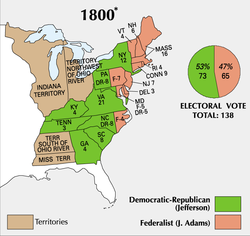
The 1800 United States presidential election was the fourth election in the history of the United States. It occurred from October 31 to December 3, 1800. This election was between the Democratic-Republican nominee, Vice President Thomas Jefferson of Virginia and the Federalist nominee, President John Adams of Massachusetts. Both Jefferson and his running mate, senator Aaron Burr of New York, had tied for first when they both won 73 electoral votes, thus sending it to the House of Representatives for a contingent election between Jefferson and Burr. Adams would come in third place as he had won 65 electoral votes.[2]
 | |||||||||||||||||||||||||||||
138 members of the Electoral College 70 electoral votes needed to win | |||||||||||||||||||||||||||||
|---|---|---|---|---|---|---|---|---|---|---|---|---|---|---|---|---|---|---|---|---|---|---|---|---|---|---|---|---|---|
| Turnout | 32.3%[1]  12.2 pp 12.2 pp | ||||||||||||||||||||||||||||
| |||||||||||||||||||||||||||||
 Presidential election results map. Green denotes states won by Jefferson/Burr and Salmon denotes states won by Adams/Pinckney. Numbers indicate the number of electoral votes cast by each state. | |||||||||||||||||||||||||||||
| |||||||||||||||||||||||||||||
1801 contingent U.S. presidential election | |||||||||||||||||||||||||||||
| |||||||||||||||||||||||||||||
16 state delegations of the House of Representatives 9 state votes needed to win | |||||||||||||||||||||||||||||
| |||||||||||||||||||||||||||||
 1801 Contingent Election Results. Green denotes states voting for Jefferson and blue denotes states voting for Burr. States in grey cast blank ballots. | |||||||||||||||||||||||||||||
As per Article 2, Section 1, Clause 3 of the Constitution, since none of the four nominees won the minimum 131 electoral votes needed to become President, the House would come together and vote among the top two candidates on who would replace incumbent President John Adams.[3]
The House of Representatives would meet nearly two weeks before the inauguration on February 17, 1801, to elect which of the two leading candidates, Jefferson or Burr, would be elected as the 3rd President. At the time of the contigegent election, there were 16 states, thus the minimum number of states needed to be elected as President was 9. Jefferson won the vote on the 36th ballot, winning 10 of the 16 states and being elected as the 3rd President, while Aaron Burr was elected as the 3rd Vice President as he won 4 of the 16 states. Two states (Delaware and South Carolina) chose to not support either Jefferson or Burr.
This election would begin the 25+ year era of control on the White House and the presidency, which would span from Mar. 1801 with the swearing in of Jefferson to his first term as President until the inauguration of Andrew Jackson as the 7th President in 1829. This was also the first presidential election in U.S. history to be a rematch as well as the first election where an incumbent president lost re-election, leading to the first time ine modern history where a national government changed hands peaceably following a free election.
This was also the last election to take place prior to the establishment of the 12th Amendment in June 1804
Background
Before the Twelfth Amendment to the United States Constitution, the second place winner was the vice president.[4] Because of this, Thomas Jefferson became John Adams' vice president even though they hated each other. This caused it to be an awkward time as the enemies had to work together. When the 1800 election rolled around, everyone was divided and furious. Adams had passed many unpopular laws like the Alien and Sedition Acts. John Adams was also called out for being too friendly with Britain, and his supporters responded by calling Jefferson supporters "Radical Atheists". This was the last election in America before the twelfth amendment was passed. There were technically two other people running, but they were more like vice presidential candidates. If electors supported one candidate, they were told to put their other vote to that candidate's unofficial vice president nominee, expecting that if they won, the other person would be in second place. John Adams' unofficial vice president candidate was Charles Cotesworth Pinckney, and Jefferson's was Aaron Burr.
Nominations
Democratic-Republican Party
 | |||||||||||||||||||||||||||||
| Thomas Jefferson | Aaron Burr | ||||||||||||||||||||||||||||
|---|---|---|---|---|---|---|---|---|---|---|---|---|---|---|---|---|---|---|---|---|---|---|---|---|---|---|---|---|---|
| for President | for Vice President | ||||||||||||||||||||||||||||
_(3x4_cropped).jpg) |
.jpg) | ||||||||||||||||||||||||||||
| 2nd Vice President of the United States (1797-1801) |
U.S. Senator from New York (1791-1797) | ||||||||||||||||||||||||||||
 | |||||||||||||||||||||||||||||
| Charles C. Pinckney | Rufus King | ||||||||||||||||||||||||||||
|---|---|---|---|---|---|---|---|---|---|---|---|---|---|---|---|---|---|---|---|---|---|---|---|---|---|---|---|---|---|
| for President | for Vice President | ||||||||||||||||||||||||||||
.jpg) |
.png) | ||||||||||||||||||||||||||||
| 2nd President of the United States (1797-1801) |
6th U.S. Minister to France (1796–1797) | ||||||||||||||||||||||||||||
Results
Thomas Jefferson and Aaron Burr both got 73 electoral votes. However, since they got the same, the Senate had to vote on which one would become president and which one would be vice president. Jefferson ended up being president. However, it was hard because the Senate was still controlled by people who didn't like Jefferson and Burr. Adams got 65 electoral votes. His vice president candidate, Pinckney, got 64, with the one other vote going to John Jay. If Adams was reelected, he wouldn't have had to deal with the Senate vote.
1800 United States Presidential Election Media

John Adams, the incumbent president in 1800, whose term expired at noon on March 4, 1801.

Results by county explicitly indicating the percentage of the winning candidate in each county. Shades of green are for Jefferson (Democratic-Republican) and shades of orange are for Adams (Federalist). Areas where voting records are missing or did not occur are in dark gray. Territories are in light gray.
ElectoralCollege1800-Large

Results by elector districts explicitly indicating the percentage of the winning candidate in each district. District boundaries or results for Tennessee could not be found

Aaron Burr tied Jefferson in the Electoral College vote.


Notes
- ↑ Each elector had two votes before the ratification of the Twelfth Amendment to the United States Constitution. Jefferson and Burr both received 73 votes, resulting in a tie. The United States House of Representatives subsequently elected Jefferson as president.
- ↑ 2.0 2.1 Of the 16 states that took part in the 1800 election, six (Kentucky, Maryland, North Carolina, Rhode Island, Tennessee, and Virginia) used some kind of popular vote. Most returns from North Carolina exist, partial returns from Kentucky exist, and all returns from Tennessee have been lost
References
- ↑ "National General Election VEP Turnout Rates, 1789-Present". United States Election Project. CQ Press.
- ↑ "Presidential Election of 1800 - 270toWin". 270toWin.com. Retrieved 2022-12-20.
- ↑ "Article II Section 1 | Constitution Annotated | Congress.gov | Library of Congress". constitution.congress.gov. Retrieved 2025-10-14.
- ↑ "Electoral College Count Generally". Cornell Law School. Retrieved 4 October 2023.
{{cite web}}: Text "LII / Legal Information Institute" ignored (help); Text "U.S. Constitution Annotated" ignored (help); Text "US Law" ignored (help)